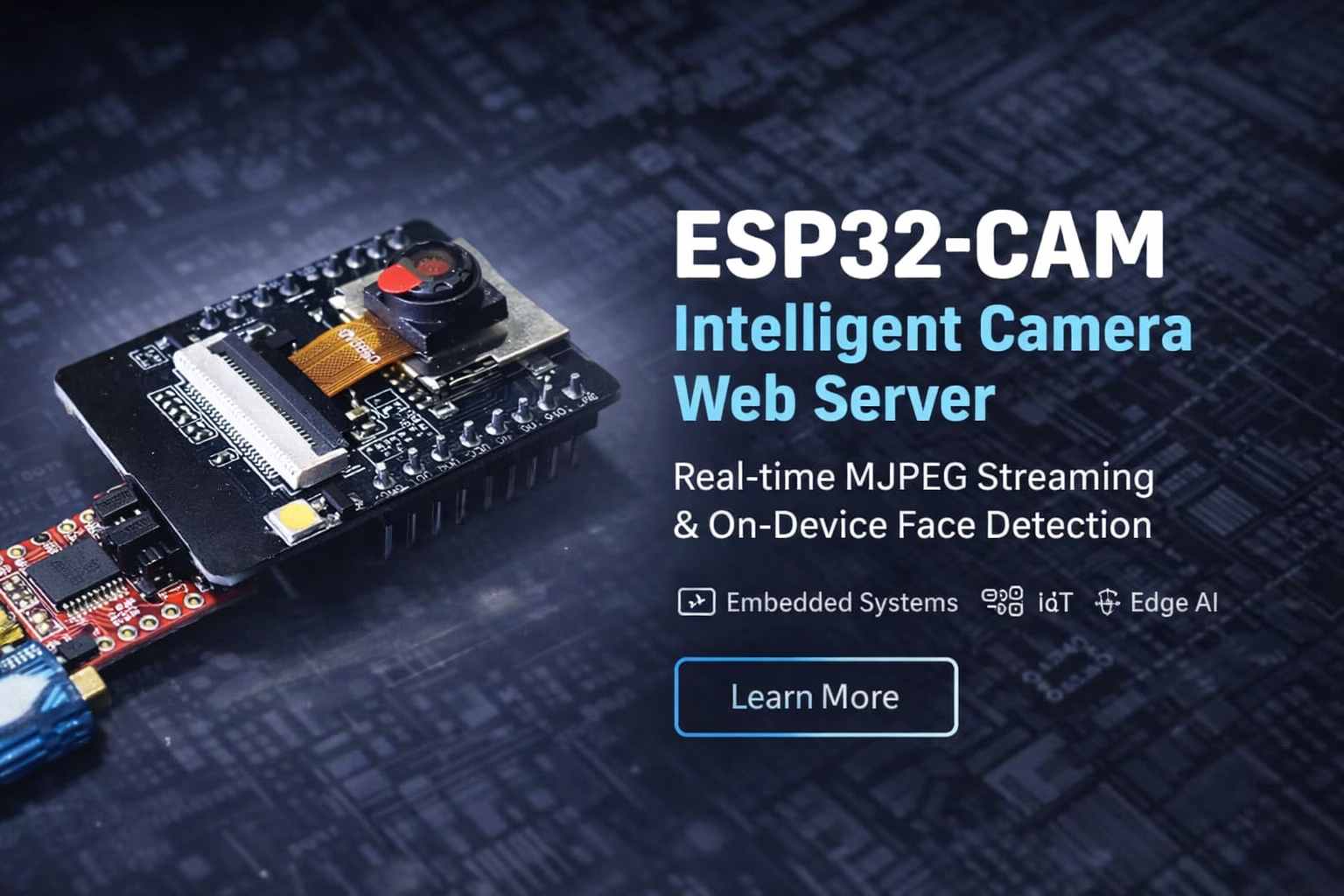
ESP32-CAM Intelligent Camera Web Server
A standalone embedded system for real-time MJPEG video streaming and on-device face detection using the ESP32-CAM module.
Embedded Systems · IoT · Edge AI · HTTP Streaming
Project Overview
This project demonstrates a low-cost embedded vision system built on the ESP32-CAM platform. It enables live video streaming and on-device face detection through a browser-accessible web interface.
The system operates entirely locally, without cloud services or PC-based processing, making it suitable for IoT prototyping, edge AI experimentation, and embedded systems education.
Hardware Used
Key Features
Core Capabilities
Live MJPEG Video Streaming
Real-time MJPEG video streaming directly from the ESP32-CAM to any modern web browser.
Browser-based Image Capture
Capture still images instantly through the web interface.
Web-based Camera Controls
Adjust resolution, image quality, and camera parameters directly from the browser.
Standalone Operation
Operates independently without cloud services, external servers, or PC-based processing.
Processing & Intelligence
On-device Face Detection
Face detection runs entirely on the ESP32-CAM, identifying faces and drawing bounding boxes in real time.
PSRAM Frame Buffering
On-board PSRAM enables efficient frame buffering for smoother streaming and processing.
LED Flash Control
Integrated LED flash improves image capture in low-light conditions.
Real-time Status Monitoring
Camera and system status are dynamically updated through the web interface.
How It Works
Camera Captures Frame
The OV2640 camera captures an image frame and sends it to the ESP32-CAM.
Frame Stored in PSRAM
Frames are temporarily buffered in PSRAM for efficient handling.
Optional Face Detection Processing
Frames may be processed for face detection, with bounding boxes drawn on detected faces.
JPEG Encoding
Frames are encoded as JPEG images to optimize transmission.
Streamed to Browser via HTTP
MJPEG streaming delivers real-time video directly to the browser.
Simplified Flow Diagram
┌─────────────────┐    ┌─────────────────┐    ┌─────────────────┐
│   OV2640        │────│   ESP32-CAM      │────│   Web Browser   │
│   Camera        │    │   (Web Server)   │    │                 │
└─────────────────┘    └─────────────────┘    └─────────────────┘
         │                       │                       │
         │  Capture Frame        │  HTTP MJPEG Stream    │
         │──────────────────────▶│──────────────────────▶│
         │                       │                       │
         │  PSRAM Buffer         │  JPEG Encoding        │
         │◀──────────────────────│◀──────────────────────│
         │                       │                       │
         │  Face Detection       │  Control Signals      │
         │◀──────────────────────│──────────────────────▶│
         └───────────────────────┘───────────────────────┘
Documentation
How It Works
Detailed explanation of system architecture and processing workflow.
Features Breakdown
Comprehensive overview of all implemented features.
Face Detection Details
Technical explanation of the face detection pipeline and constraints.
Code Architecture
Overview of camera initialization, web server handlers, and streaming logic.
Hardware Requirements
Complete list of physical components used in this project.
Software Setup
Environment setup, board configuration, and required libraries.
Performance & Limitations
Measured performance characteristics and known constraints.
Applications
Example use cases for this system.
Face Detection & Recognition
Face Detection
The system performs real-time face detection entirely on the ESP32-CAM.
- Runs entirely on-device
- Detects human faces in real time
- Draws bounding boxes on frames
- No external processing required
Face Recognition
Face recognition is not supported on ESP32 hardware due to processing limitations.
- Not supported on ESP32 hardware
- Requires significantly higher processing capability
- Intended for ESP32-S3–based systems
Important Note
The "Enroll Face" option is limited by ESP32 hardware constraints. This project focuses on face detection only, not recognition.
Performance & Limitations
Performance
-
Real-time MJPEG video streaming
Smooth video streaming directly to web browsers
-
Adjustable resolution and image quality
Configurable settings to balance performance and quality
-
LED-assisted low-light capture
Built-in LED flash for improved capture in low-light conditions
Limitations
-
Limited FPS due to CPU constraints
Frame rate is limited by the ESP32's processing power
-
Face detection works best at low resolution
Higher resolutions impact performance and detection accuracy
-
No real-time face recognition on ESP32
Face recognition requires more processing power than ESP32 provides
Applications
Basic Smart Surveillance (Prototype-level)
Ideal for home security and monitoring applications with real-time face detection capabilities.
IoT Visual Monitoring Nodes
Perfect for distributed IoT networks requiring visual monitoring and edge processing.
Embedded AI Demonstrations
Excellent platform for showcasing AI capabilities on resource-constrained devices.
Educational Projects
Great for teaching embedded systems, IoT, and computer vision concepts.
Attendance Systems (ESP32-S3)
With ESP32-S3 upgrade, can be used for face recognition-based attendance tracking.
Prototype Industrial Monitoring
Suitable for monitoring production lines, safety compliance, and personnel tracking.
What This Project Does NOT Do
Out of Scope
- No cloud-based processing
- No face recognition on ESP32
- No external AI hardware
- No advanced video codecs (MJPEG only)
Conclusion
This project demonstrates how a low-cost ESP32-CAM can be used to build a complete, standalone camera web server with real-time MJPEG streaming and on-device face detection.
It highlights:
Future Improvements (Optional)
-
ESP32-S3 Migration for face recognition
ESP32-S3 offers improved vector performance, making face recognition more feasible compared to ESP32.
-
Enhanced Web Dashboard UI
A more advanced web dashboard with analytics, detection history, and enhanced configuration options.
-
Event-driven capture and detection
External AI processing could be explored in future iterations but is not part of the current implementation.
About the Author

Mayank Kulkarni
Embedded Systems | Full-Stack | IoT | AI | Full Stack Developer
Founder of MKTechs & Zervista
https://mayank.wikiExpert in embedded systems, IoT, and edge AI technologies. Specializing in full-stack development and innovative technology solutions.